Thursday, May 26, 2011

One Small Step for Jesus' Disciples, One Giant Leap for the Early Church...

Our readings for this sixth Sunday in Eastertide come from Acts 17:22-31 (though I would recommend expanding this to include verses 16-21 and 32--we will do this on Sunday!), 1 Peter 3:13-22, and John 14:15-21. They can be read here.

It doesn't take much for us to jump from last week's Gospel reading in John 14:1-14 to this week's in John 14:15-21; in fact, in our last Bible study at church I heard one person express frustration that these passages were divided at all--like much of John's Gospel, they flow into one another and need one another to be fully heard! John 14:15-21 continues Jesus' farewell discourse to his disciples, giving them another reason to trust him--that another Advocate will be sent to them so they will not have to journey alone even after his imminent bodily departure from them. It's a nice appendix to Jesus' words of reassurance from last week.

The Acts reading, however, requires a giant leap of time, imagination, and context for us to enter into. Last week, a man named Saul approved of the death of Stephen, outside of the gates of Jerusalem; this week he stands in Athens, Greece, with a new name and a new mission--to take up the work of proclamation for which Stephen had been killed. While all of our other readings from Acts this lectionary year come from chapters 1-7 this one randomly propels us all the way to chapter 17. While all our other stories from Acts the past few weeks (and in the next two) took/will take place in Jerusalem, this one puts us nearly a thousand miles northwest of there. Previously the Gospel has been proclaimed to Jews or, at least, people who knew Jewish ways; now we find the Gospel being proclaimed to Stoics and Epicureans, to people who fill their marketplace with idols to every imaginable God, for whom Socrates was more familiar than Moses. We have leaped forward with the Gospel into a whole new world, one that's far from the home base out of which we've been operating.

Since we'll be operating in a new cultural landscape with this portion of Acts this week, I thought we could have a quick lesson on some of the strange terms in this passage which help us understand where Paul wasas he carried the news of Jesus somewhere it had likely never been before. So, here's a quick vocab lesson (I am indebted to the New Interpreter's Bible for much of this info):

Among those Paul meets in Athens are “Epicurean and Stoic philosophers." Who were these guys? Here are a couple of incredibly oversimplified intros:

Epicureans believed that the avoidance of pain and suffering is the true aim of this life. They felt that a personal, provident god–a god who could make a practical difference in the outcome of a happy life–simply does not exist, so religious devotion does not matter as much as living a life of simple pleasures. Epicureans would not have thought much of all the idols in Athens, most likely, since they didn't expect any of these gods was expected to intervene and make a difference.

Stoics, meanwhile, were guided by their analytical observations and careful reasoning. They sought to live in harmony with the cosmos because they believed the deity was in all things--the "live and move and have our being" reference that Paul drops would have made them cheer and nod in agreement, it probably came from one of their writers! Yet the idea that God could be personalized in someone like Jesus would have been deeply troubling to them and, like the Epicureans, the idea of any life beyond this one seemed a ludicrous concept.

Paul's encounter with these groups led him to the Aeropagus--an elevated, open-air site just to the west of the acropolis in Athens (see picture at right--anyone want to join me on a field trip?). The Areopagus was the equivalent of a city assembly or council that would hear public debates and give verdicts. Paul may well have been taken there to determine whether he has the credentials to bring his “strange teaching” into a place as sophisticated and learned as Athens, where he wanders as a strange curiosity but not necessarily one with any credibility.

Paul's trip to Athens is a bit overwhelming, especially when it takes us so far out of the context we've been in before, into a world of strange new terms and unfamiliar settings. It makes me wonder how Paul's engagement of this whole new context might challenge us as Christ's church to not just move in logical, linear ways, but be willing to immerse ourselves in places totally foreign to us--to deeply encounter and hear what our neighbors think, to open ourselves up to their judgment rather than passing judgment on them, to speak with conviction what we believe even if people look at us like we've grown approximately seventeen heads. To continue our "Growing up" theme from last week, where might this text challenge us to move from tentative baby steps to giant leaps for the sake of living out Jesus' commandment to love our neighbors as ourselves?

Thursday, May 19, 2011

The Way

For this fifth Sunday of Eastertide, as we continue to consider the implications of a risen Christ for our life together as God's people on this earth, the passages that will guide our reflection come from Acts 7:55-60 (though this is among the lectionary's more absurd choices; you really need to read the whole of chapters 6 and 7 to have any sense of what these 6 verses are about!); 1 Peter 2:2-10; and John 14:1-14, which can be read here.

There are about 1,000 things I either want to say or feel need to be said (or, at least, discussed) about this Sunday's Gospel reading--parts of which are among the most familiar things Jesus ever said, parts of which sound like they are still in the original Greek and lacking a clear translation for all the sense they make. After spending some time last Sunday dwelling in Jesus' beautiful image provided in his statement, "I am the gate," however...I wondered if it would be more fruitful this week to continue a visual approach to the Gospel and to consider what we picture when Jesus offers another of his "I am" declarations here: "I am the way."

I did a Google Images search for pictures that come up when you type in "I am the way, the truth, and the life", and the myriad pictures of different ways that came up were fascinating to me. You got a lot of pictures that are similar to this in genre and content:

A lot of words are added to Jesus' declaration in this picture...loaded words, interpretive words....words which may not have been Jesus' intention in offering us this image. Yet other accounts offer a similar theological interpretation without words. I found this one particularly interesting...and disturbing, the more I look at it:

Bridges seem a common motif to depict "the way," whether starkly photographed or whimsically imagined:


Artists have been captured by this description of Jesus, finding a wide variety of ways to sketch and paint representations of the way:

Then there's this, a way that looks like there is within it, ironically, no way through at all:
There are some images of the way that look common enough that they could be found in our neighborhood, even in our own backyard:


And then there are some ways that take a different shape than any road or path we've ever thought about before:


As I scrolled through all of these and many more images, looking for a concept of what it might mean to think of Jesus as "way," (which can also be translated "road" or "path", in case you wondered!), I found some interesting, but none that were like, "Yes! That's it!" So my question to you is...based upon what YOU know of Jesus...if you were to photograph, draw, or depict what sort of way you think Jesus is...what might you contribute to this series of images? Which images draw you in, if any? Which appall you, if any? Is there only one way to picture this way, or many?

A picture does indeed paint a thousand words...or, in this case, at least, those ten vivid words shared by Jesus: "I am the way, and the truth, and the life." May we all enter into the mysterious imagination of the fullness of what those rich words might convey and invite us into.

Thursday, May 12, 2011

Does Jesus Really Know Us?

Our scripture texts this week are Acts 2:42-47, 1 Peter 2:19-25, and John 10:1-10, which you can read in full here.

The fourth Sunday in Eastertide is traditionally "Good Shepherd Sunday," a time for us to contemplate the idea of the risen Christ as "the shepherd and guardian of our souls," as Peter's epistle describes him, or as the One who calls the sheep by name and leads them out that they may find pasture, as John's Gospel describes him.

Our Wednesday night prayer and meditation group spent some time with the Gospel text last night, and though this is a text I have read innumerable times (because I find John 10:10 one of the most significant and mystifying verses in all of scripture), I was struck by something I had never been struck by before. I'm still turning it over in my head this morning, so as I shared it with the group last night I will share it now with you:

In verse 8, Jesus says, "All who came before me are thieves and bandits; but the sheep did not listen to them." This is in a similar vein to the claim Jesus made back in verse 5 about his sheep: "They will not follow a stranger, but they will run from him because they do not know the voice of strangers." I read this last night, and alarms began to go off in my head for what now seems a ridiculously obvious reason: Um, Jesus...I don't know if you've noticed or not, but we listen to thieves and bandits constantly. We run after strangers like it's our job, if it seems like they'll lead us somewhere that will satisfy our needs. So how can you say we have not done this in the past and will not do it in the future? You claim to know us...but these two verses make me wonder if you really do.

So what is Jesus doing here? Is this the power of positive thinking? Does Jesus think that if he plants seeds of a different way in our minds, we'll begin to realize there is another way and live into his words? This makes sense for the passage about our future...but what about what he said about our past? Is this a statement of forgiveness--that Jesus is just not even going to remember that we listened to the thieves in the past, is giving us a fresh start, clean slate, new way to live?

What do you think? I really am intrigued by this. I'd encourage you to read another blog post I ran across last night that asks some of these questions at The Hardest Question, a lectionary site whose honesty I really appreciate. Then join us on Sunday as we seek to know better this Shepherd who claims to know us intimately, to figure out how to shape our futures together in a way that reflects His character in our community...no matter how wayward and misled we may have been in the past.

Thursday, May 5, 2011

Wondering Again

On this third Sunday in Eastertide--the season we have been given in which to continue to celebrate the resurrection and to enter into its mystery, trying to figure out what a risen Christ means for the life we live NOW--our texts are Acts 2:36-41 (though I will be including 32 and 33, just for context), 1 Peter 1:17-23, and Luke 24:13-35. You can read them here.

A couple of months back, I wrote in a blog about the power of "wondering" questions--questions that do not have clear-cut answers but that invite us deeper into the mystery of the story. I find this week's stories full of mystery--a mysterious companion on a journey, a mysterious disappearance, mysterious languages spoken that draw a crowd that by some great mystery hears truth and joins the fellowship of Jesus' followers. So it seemed like this might be a good time to offer some more "wondering" questions about our passages.

Though I will be focusing more on the Acts readings than the Gospel readings in this Eastertide season (though, as Jeremy pointed out last week, this will be with the intention of seeing how the early church was shaped by these resurrection Gospel stories--so really we'll be reading the stories in conversation with one another!), it is Jesus' mysterious appearance in Luke that makes me wonder most this week:

  • I wonder why the two travelers were headed to Emmaus. It seems like the messages from Jesus on that Easter morning were either to head to Galilee or to remain in Jerusalem...what are these folks doing heading to this random village that we know little about besides the fact that it was seven miles from Jerusalem?
  • I wonder why we only learn the name of one of the disciples on the road to Emmaus...and why this is a disciple we have never heard from before, nor hear from after.
  • I wonder why, even though they can tell the story of Jesus' death and resurrection with accuracy and clarity, the two on the road remain sad even as they speak what is good news.
  • I wonder what Jesus said to interpret the scriptures from Moses to the prophets to the recent events in Jerusalem...wow, don't you wish we'd gotten than conversation recorded??
  • I wonder why Jesus walked ahead as if he was going on...did he really intend to continue, and if so, to where? If not, I wonder why he made it look as if he was going on?
  • I wonder why the two disciples were so intent on forcing him to stay...the verb used here means literally "to twist one's arm."
  • I wonder why Jesus vanished as soon as they recognized him...and where he went!
A couple of wondering questions from Acts as well:
  • I wonder what the "many other arguments" were that Peter used that brought about such an incredible change in that crowd gathered in Jerusalem, that turned them from mocking the disciples to joining their ranks?
  • I wonder why it was Peter--the one who denied Jesus!--who gave this first sermon of the church, who could speak with such conviction and certainty.
As we wonder, may we find our hearts burning within us in the days to come as we consider the wonder-fullness of the resurrection story and the ways it reshapes the story we live this day.

Wednesday, April 27, 2011

The Rebellious Child and the New Church

Note: While Abby is away this week, you get me (Jeremy). Don't worry - it's only temporary and I'll keep it brief! http://www.blogger.com/img/blank.gif


A Bible study brunch at Broadneck is a lively thing. Lots of good questions, thoughtful folks sharing ideas, and (of course) plenty of tasty food to help fuel all of this. Maybe it is these things which made me think of Passover and the Seder - a time of re-living faith stories and questions around a shared meal. As we looked at this week's passages (John 20:19-31 and Acts 2:14-32), Abby invited us to think about how these visits from the resurrected Jesus and Peter's speech to a mocking crowd might have influenced the development of the early church. Paraphrasing the rebellious child (one of the four children used as symbolic questioners during the Seder), I wondered, "What's this mean to all of you?" Or, as Jolly put it last week, "What's it to ya, bub?"

I think this is a great question that Abby raises, and it's one that Stephen (our former interim and member) raised, and I think it should be in our thoughts anytime we try to think about our life together as community. By looking at the diversity and challenges within early faith communities and churches (!) and how they were addressed, there is a lot we can/should learn and ideas that we should continue to reflect on if we are to embody Jesus in the world.

So, what do I sense in these passages about the disciples, community, and following Jesus? Quite a few things, actually, some of which might be interesting to you, some of which probably aren't, and some that might be useful in a broader context. Briefly:

1. Just as we see his humanity throughout Jesus' life, we see honesty in emotional reactions in both the Easter scriptures and in this passage in John. Joy, fear, apprehension, awe, guilt, anger, relief, and a dozen other feelings are expressed here. Everyone involved - even the initially mocking crowds - illustrates how diverse reactions were to this new angle of relationship with God. In the passage from John (and in the resurrection texts), Jesus spends quite a bit of time just trying to calm folks down and get them to really see a new reality. Peter seems to attempt to do something similiar, illustrating that Jesus is trying to free us from fear of death. Just as God didn't abandon Jesus to the Pit/Sheol/Hades, neither will God abandon you. For all our supposed enlightenment and rationality and logic, seems to me that we are just as driven by our emotions and still in need of peace in order to begin to understand the reality of life around us.

2. Connected with these emotions, we see a spectrum of faith. In my reading and experience, there's a tension between faith and a "need" for proof that, it would appear, has been pretty consistent through quite a bit of human history. Jesus appears (at least twice) in a locked room next to some already freaked out disciples and has to show them his wounds. Hearing about this from people he trusted with other vital things wasn't enough for Thomas - he has to touch to believe. Where are you on this spectrum? How and why does it change from time to time? Why are some things so easy to take "on faith," but others require tangible evidence? I don't think this tension is a bad thing, entirely - just a part of being human. But how to live with it? Last point on this issue: Not one disciple called Thomas a jerk/heathen/unbeliever for expressing his honest doubts, or kicked him out of the group. Interesting, no?

3. Peter's speech wasn't just for the culturally recognized leaders (elder men). He addressed slaves, women, men of Judea and all the various peoples of Jerusalem. This supports Jesus' message and actions of equality and of changing how we perceive and interact with and value others.

4. When Jesus' empowers the disciples here in John to forgive, is this really a new thing, or just drawing attention to the power we all hold? I invite you to read the different translations side by side of John 20:23 here. The question isn't what is retained or held, but who does the holding. The Greek tenses and words used seem to indicate a duality between continual retention and instant release (as well as who does the retaining) that isn't exactly clear in most translations. In any case, it doesn't seem to say that God cedes power of ultimate forgiveness to the disciples, and instead points out that it's up to them if they want to carry around another person's sins. Obvious a statement it may be, but I think it shows a struggle that we experience daily in how we approach forgiveness. How much do we hold onto the wrongs of others, and why? Are we going to approach forgiveness as a transaction, a "gift" that must be reciprocated, and which isn't truly a gift? (see Miroslav Volf and his book "Free of Charge" on this one, if you like, or some Marcel Mauss on "The Gift")


What's all this to you, oh rebellious child? What's this to you, oh church?


Peace to you all from a rebellious child,

Jeremy

Friday, April 22, 2011

Some Reflections on Good Friday

I have decided to use the blog a little differently this week. There are a couple of reasons for this: first, it seems a little strange to me to blog on Resurrection texts in the days that mark Jesus' death, days when an outcome of resurrection was far from certain. Second, since we are not "officially" gathering as a faith community on Good Friday (though I hope those of you who are able will join us for the Community Crosswalk beginning at Noon at Broadneck, rain or shine), I thought that it could be useful to reflect on the story and meaning of this day instead of moving to our Sunday Sermon Scriptures (which I hope you will still read ahead of time here--we'll be using the Matthew Gospel text, the Jeremiah reading and the Acts reading). So here are some reflections for your Good Friday:

Last year, I spent Good Friday in France, believe it or not. While visiting family in Germany, I took the train across the border to spend the day in the picturesque village of Strasbourg. After visiting a Catholic cathedral with powerful depictions of the crucifixion and a Lutheran church that dated back to the days of...well...Luther, I sort of accidentally stumbled into a Good Friday service taking place in a Protestant church not far from the center of town. I crept into the back and took my place in a pew, hoping I could be a worshipper and not a tourist. One of the congregants handed me a bulletin, and I graciously accepted it as I settled in to listen.

Now, I took French in high school, but that was a loooong time ago. Hence, most of the words of songs and prayers in this service were lost on me. But as various people got up to read the words of the Passion story from Matthew's gospel...I found that I recognized every word. Even when I didn't know the exact meaning of the language, I understood the exact meaning of their message--the agony, abandonment, hopelessness, and derision portrayed in every syllable. It was one of the most powerful experiences of hearing the Good Friday narrative I've ever had, and rather than continuing my village wanderings I sat in that chapel for a long time afterwards reflecting on it.


Hearing the story in a language foreign to me and yet recognizing every word of it made me wonder--is such deep comprehension part of what makes this story of Jesus' death so powerful? A demonstration of love unto death is something that can be understood across time, across cultures. Suffering is something with which anyone who has lived more than a few years, no matter their background, is well acquainted. Is this why we keep crosses in our sanctuaries and hang them around our necks even though they are gruesome instruments of death--because somehow, in that sharing in Jesus' suffering and reminder of it, we are brought closer to Jesus than at any other time? That this is God's love made visible in a way that we cannot understand, yet at the same time understand deeply as people who, too, have suffered?


I also have often wondered, if Easter is the central event of the Christian faith, why we don't put empty tombs in our churches or on our jewelry. I wonder if this is because death is something far more tangible for us, more comprehensible, than the tremendous mystery that is resurrection. We've all known suffering; but we have not all known resurrection. Most of us, in spite of the fact that we now live in what Walter Brueggeman called an "Eastered World", live in places that look more like Friday or Saturday than Sunday: places marked with disappointment, with brokenness, with suffering. I think this was true even for the early church: after all, the Gospel writers devoted dozens of verses to Jesus' death but struggled to come up with more than a few words to describe the resurrection. How can such a mystery that none of use have yet experienced be named? There were many witnesses to the crucifixion...but no one, as best as we can tell, saw Jesus rising with their own eyes. A select few saw him post-resurrection, but the rest of us were left to depend on the fearful and joyful witness of those few to this unknown.


I am not sure where all these somewhat rambling wonderings lead...but perhaps this is what Easter faith is, at its heart: living into the mystery of God with the full spectrum of our wonder. In this day, however, I continue to ask: what does it mean to have as the core, universal symbol of our faith a story of intense suffering? As we gaze upon a day of pain that cuts to our souls, how might we begin to imagine an Easter morning that points beyond any adequate description? How might we learn to see and receive the sudden, surprising and never-before-seen gift of incomprehensible life beyond our visible and all-too-real knowledge of death?

Thursday, April 14, 2011

Overwhelming Shifts

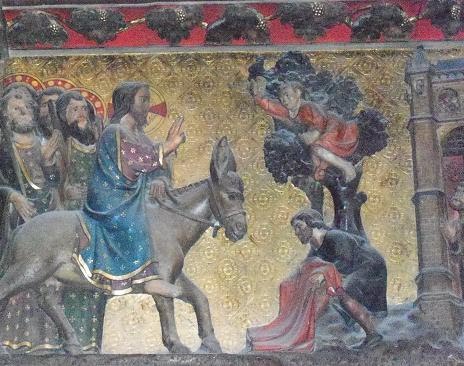
The lectionary texts for this Palm/Passion Sunday are myriad--it is the only day of the church year that recommends two totally different sets of readings in the same time of worship. This week, we will be focusing on the Gospel readings--Matthew 21:1-11 and Matthew 27:11-54--with an assist from the Epistle reading, Philippians 2:5-11. They are full, full, full, so spend some time with the first set of readings as well as the second set before we gather around them and delve into them on Sunday.


Palm/Passion Sunday, the final Sunday of the Lenten season, is full of shifts, shifts that can quickly overwhelm even those of us familiar with the stories and events that mark this day. I think the shift is supposed to feel abrupt--because what will happen in this Holy Week is harsh and abrupt, no matter how much Jesus' entire life and ministry seems to have been tending towards this showdown in Jerusalem. But I thought I would help us lean into Palm Sunday by highlighting just a few of the shifts that happen here:


1) In terms of our lectionary-guided journey, we move from John's account of the Gospel story which we have been immersed in for the past four weeks back to Matthew's account. Though both writers tell the same story, their accounts sound radically different in our ears. John's language of seeing and hearing and belief is replaced by Matthew's language of kingdoms and Old Testament fulfillment and Messiahs, linking the Jesus story more strongly back to its Jewish roots and the way Jesus came into radical conflict with the secular and religious powers of his day. If John is the lofty gospel that helps us make divine connections, Matthew brings us strongly back to earth, showing Jesus in his very particular social and political context and making some statements with his words and life that end up getting him killed.


2) We've spent the past four weeks with Jesus in very intimate settings, looking at individuals working out their understanding of Jesus in one-on-one dialogue and interaction. Jesus has had some of the longest conversations we see from him in scripture with folks ranging from an old Pharisee to an isolated woman to a formerly blind man cast out of the synagogue to a grieving sister. This week, such intimate conversations are a thing of the past; we are thrust into the crowds, shoulder to shoulder with other palm-waving pilgrims, moved along by the tide of the crowd like revelers in Times Square on New Year's Eve, a tide that carries us through Pilate's courts and ultimately up a hill from which we will all scatter. How does the way we interact with Jesus and view him change as the formerly chatty Jesus falls eerily silent and the voices that fill our ears are those of the crowd around us?


3) The readings for this day take us from shouts of praise to shouts of death...how does this happen so quickly? How can people so sure of Jesus' identity one day want to crucify him for it barely a few hours later? What happens in that gap between palms and passion to provoke such a turn?


I'd encourage you, if you have time this week, to read not just the two Matthew bookends appointed for this day, but the entire narrative that unfolds from Matthew 21 to Matthew 27. This is the overwhelming narrative that shifts Christ's future from acclaimed Messiah to crucified criminal...and as we let it wash over us, it just may shift our futures as well.